
The interesting thing with AI is I’ve never seen a technology that’s been so successfully adopted by Wall Street and by investors and by tech companies that the public has so thoroughly rejected. (Christopher Nolan, 2026 quoted in The Guardian).
What man actually needs is not a tensionless state but rather the striving and struggling for some goal worthy of him. What he needs is not the discharge of tension at any cost, but the call of a potential meaning waiting to be fulfilled by him. (Viktor Frankl, 1946)
At the 2009 Semantic Web Conference in San Jose Tom Gruber, the CTO and Co-Founder of a small company called Siri, presented their Virtual Personal Assistant - Bringing Intelligence to the Interface through having ‘a conversation with someone you trust’. Gruber, and many like him, was inspired by Apple Computer’s Knowledge Navigator (Apple 1987) and the work of Alan Kay, in particular his concept of the Dynabook (Wikipedia 2026).
Gruber didn’t just envisage Siri as a glorified search engine, he painted a vision of a Virtual Personal Assistant that understands its’ ‘master’ well enough to actually do things in the real world (Gruber 2009) and help make life easier.
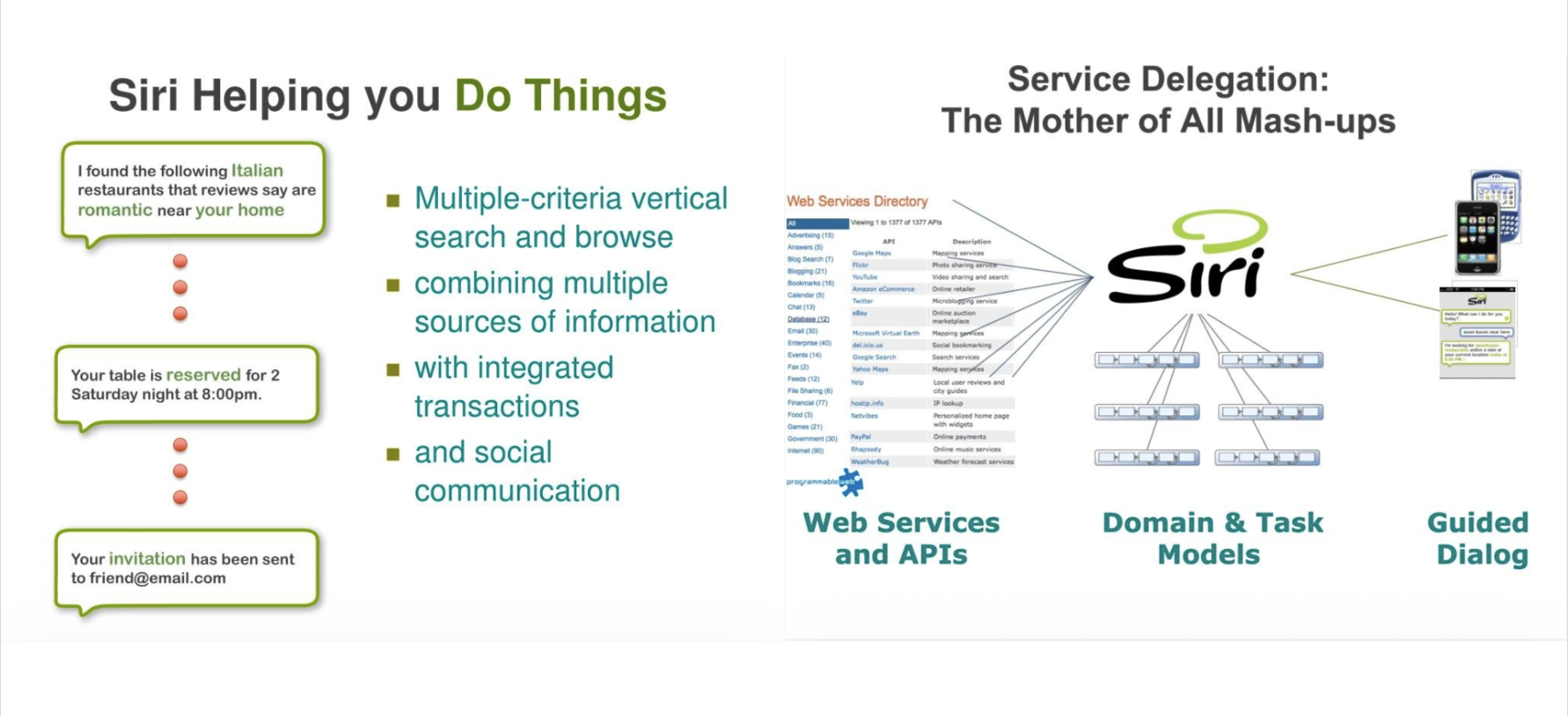
For those of us listening to this presentation in 2009 what Tom presented was breath-taking.
In the tech-space the Apple iPhone had only recently‘ landed’ in 2007 and by 2009 around 20 million people had become used to having a computer more powerful and much smarter than that onboard Apollo 11 Computer in their pockets (Lescop and Lescop 2013). These small devices and others like them began to revolutionise the relationship between humans and the smart machine seamlessly integrating them into every aspect of our lives (Zuboff 1989).
But what does this mean for us as human beings, our value in society and our sense of self-worth? How can we make sure that these incredible technologies are a force for good?
This is the question I chose to focus on for my most recent assignment as part of my MA in Artificial Intelligence assignment considering three things.
The first is Homo Economicus, the concept of the human being as a classical economic abstraction of a person who acts as a perfectly rational, self-interested utility-maximiser, weighing all available information to make optimal decisions. The measurement of value is where Humans are seen as economic units with the broader system where worth is liked to productivity and output.
The second is the link between generative AI and the creative process itself.
The third is how both of these may link to Eudaimonia, Aristotle’s idea human flourishing which requires not just passively living a good life but requires the ongoing exercise of virtue and practical wisdom (phronesis), building the capacity to deliberate well, built through habituation (Makrakis 2026).
This article documents my own thought processes as I wrote this assignment and includes my interactions with Claude.ai as my collaborator and sparring partner. I also used Google Gemini through my searches which I tried to do instead of using Claude whenever possible.

Throughout human history we have placed a value on education defined as the lifelong process of acquiring and sharing knowledge, skills,values, and critical thinking (UNESCO 2026).
In tribal societies education was crucial for human survival; after the invention of agriculture it was central to administration and religious record-keeping; in the Renaissance and Enlightenment the focus was on the cultivation of reason and individual inquiry; in the Industrial Revolution it served to produce literate, disciplined workers for factories and as citizens who could participate in expanding democracies (Stanford 2026). In the 21st Century education is now seen as key to employment and social equityand organisations see it as a means to accelerate organisational learning(Morrison 2026).
Universities are a part of this system and as such the website for this MA in Artificial Intelligence course states that:
If you want to develop AI expertise and make a positive impact in your work, this online master's degree is for you. … This programme gives you the tools to succeed … lead AI adoption, manage AI projects, or make tech decisions … for AI-savvy professionals (who) must use AI to solve society's urgent challenges … (and) understand AI and its impact … (to) manage complexity and achieve results (University of Southampton 2026).
This goes to the heart of the major challenge society is facing with the adoption of AI – it’s intricate link with Capitalism and ther ole of human beings as economic cogs in the Capitalist wheel. If we are to explore the economic and cultural impact of generative AI we must see it within the broader socio-economic system.
It’s easier to imagine the end of the world than the end of capitalism. How can we plan for a different world if we can’t even conceptualise it? Capitalism has completely colonised our world views, so that we literally cannot imagine a world where we are not assigned an economic value (Mark Fisher 2009 and Kelly 2026).
This discourse has dominated much of the media and focus around the AI revolution, and even people such as Demis Hassabis, who has always stated that he has bigger picture goals and perspective, stresses that
People must learn how to use new AI models in order to excel professionally in the future and not risk getting left behind … In the limited-resource world which we're in, things ultimately become zero-sum (Hassabis 2025).
In other words humans must be educated to use the tools to continue to be useful in the system.
But what about those who don’t and are happily doing the mundane intellectual work?
Geoffrey Hinton, the so-called Godfather of AI, believes that the only jobs left will be creative ones (Shibu 2025 and Hinton 2025). Anthropic CEO Jack Clark suggests that it is those with a liberal arts education who will be needed in the future (Faisal2026) and the technology companies are now hiring philosophers to help train the models through the use of deontology and consequentialism (Economist 2026).
Homo Economicus now seeps into philosophy.
I asked Claude.ai: What is the link between Homo-Economicus and the age of AI?
Claude: The link is fairly direct: AI is turning ane conomic thought experiment into an operational reality.Homo Economicus is the classical economics abstraction of a person who acts as a perfectly rational, self-interested utility-maximizer ... Economists always knew this was a simplification. … AI changes the relationship to this model in two ways.
First, AI systems are quite literally engineered to be what Homo Economicus was only theorized to be. … Some economists and AI researchers now use the term "machina economicus" (Sharma2020) for this … AI is the model Homo Economicus finally has a real referent.
Second, this flips old theoretical machinery back into relevance. Decision theory, game theory, and mechanism design were built assuming rational actors … AI can be made to actually satisfy the rationality axioms humans routinely violate.
Many in the Tech Industry, like Mo Gawdat (Gawdat 2023), foresee that this will eventually lead to a type of Utopia and age of abundance for all, albeit going through a rather messy transition on the way. People like Geoffrey Hinton are more concerned suggesting that there may be some negative sides to this:
If you make lots and lots of people unemployed, even if they get universal basic income, they’re not going to be happy. Because they need purpose … they need to feel they’re contributing something (Geoffrey Hinton2025).
So, what might a “world without work” look like? Journalist Brigid Delaney explores the idea concluding that
It might seem unlikely at this moment, but under the right conditions, the abundance that AI promises to deliver would represent an enormous and radical opportunity – a chance to reconnect with the ancient project of how to live. In this there is the promise of nothing less than the total shift from a human doing to becoming a human being. (Delaney 2026).
So what does human being look like?
Prompt: In this article (Delaney 2026) Brigid Delaney talks about a shift from human doing to human being with the age of AI. How would you envisage that such a world would operate?
Claude: She sees dignity relocated to personhood rather than output, humans rejoining the natural order rather than exploiting it. … "Human being" doesn't mean unstructured; it means the structure has to be chosen rather than imposed by an employer.
Claude clarifies that throughout history where the elite have flourished outside ‘work’ it has been dependent on a human ‘underclass’. Economically there is work to be done and the ‘promise’ of AI is that the machines take on this work, which in itself is dependent on the human work still required.
So the inequality shifts from being between humans to being between humans and machines.
Prompt: How could Generative AI techniques enhance the concept of the 'human being' rather than the 'human doing'?
Claude came up with a number of suggestions.
Firstly, the key distinction is between generative AI as a replacement for an activity versus a scaffold for developing mastery in it. It suggests that AI as collaborator or tutor rather than ‘vending machine’ (Hasse and Pokutta 2024) could boost creative output.
Secondly, the use of generative AI as a standing interlocutor for reflection, journaling, or philosophical conversation, available on demand something that is a genuinely novel capability.
Thirdly, relationship and community could be enhanced through multimodal generation to enhance communication, communal memory making co-creating rituals, generating shared narrative artifacts for a group rather than individual content for a feed. That's"being" in the relational sense.
Claude concluded: The honest caveat is that none of this is where current generative AI products are actually optimised to go. Most are built on attention-economy logic … So whether generative AI actually serves "being" over "doing" isn't a property of the technology — it depends on the same ownership and design-incentive question … who's building these tools, and whether they're optimized for depth of practice and connection or for engagement metrics.
Back to the Homo Economicus.
The more I thought about this the more my mind shifted to the concept of Eudaimonia, often defined as the ultimate human good resulting from a virtuous life aligned with one's true self (Perannagari 2026).
Eudaimonic living can be characterised in terms of four motivational concepts:
· pursuing intrinsic goals and values for their own sake
· behaving with autonomy and agency
· volition and consent rather than being controlled; being mindful and acting with a sense of awareness; and
· behaving in ways that satisfy basic psychological needs (Ryan et al 2008).
Prompt: So it seems like we are moving towards the relationship between generative AI and Eudaimonia. What are your thought around this?
Claude found this question complicated and unsettling: If eudaimonia requires ongoing exercise of virtue and practical wisdom (phronesis) — the capacity to deliberate well, built through habituation — then the emerging data on generative AI and cognitive offloading is a direct hit against it, not a side concern.
Claude referenced research linking the frequent use of AI and declining Critical Thinking scores (Bodell 2025, Lee et al 2025):
The "hollowed mind" language from the offloading research is about the sharpest way I've seen that put: comprehensive answers without the effortful processing that made ancient philosophers think this stuff was worth doing at all.
This links to the work of David Chalmers whom I had once heard talk about Cognitive Offloading and the Extended Mind:
People say, "Is Google making us stupid?" … Well, if I'm right about the extended mind thesis, there's a sense in which Google is actually making us smarter. Google is getting inside our minds (Chalmers 2011).
In 2017 Pattie Maes reflected back on the iPhone arguing that as a result of it becoming the Extended Mind humans have already become Cyborgs but that our smart machines need to be redesigned to become a sort of sixth sense, a digital Memory Palace and a more seamless extension of ourselves (Maes 2017).
Since that time the concept of Symbiopersonal Intelligence (Mensah et al 2025) has evolved (Schleidgen et al 2026) across many fields which some see as leading towards the Trans-human future (Istfan2015 and Transhumanist Party 2026).
We argue that attempting to build something akin to a god is an inherently unsafe practice, and urge researchers and practitioners to abandon this goal in lieu of building well-defined, well-scoped systems that prioritise people’s safety (Gebru and Torres 2024).
As David Chalmers has said
A year spent working in artificial intelligence is enough to make you believe in God. (David Chalmers, 2024)
So now we are moving to philosophy, theology and the realm of the spiritual. The perfect segue to creativity.
Vassily Kandinsky and Arnold Schönberg met in 2011 and from that time corresponded regularly exploring early 20th Century ideas on abstraction, expression and the spiritual bond between art and music (Schönberg and Kandinsky, 1984). Kandinsky sought to discover scientific laws around the emotional response to colour, line and form which he published in his seminal Concerning The Spiritual in Art (Kandinsky 2011).
The link between creativity and the spiritual seems to be inherent in human beings. In addition,we are often at our most creative when we are not focusing but our minds are wandering (Gonçalves 2023).
Prompt: With all of this in mind Claude what then is true 'creativity'? And what does it mean for humans, beyond now putting in a prompt and asking a machine to 'create' something?
Claude was very taken by an article by Popova (Popova 2025) and in particular the work of Margaret Boden (Boden 1992).
Boden identifies three kinds of creativity: combinational (unfamiliar combinations of familiar ideas) exploratory (navigating within an existing conceptual space — a genre, a style, a set of rules) and transformational (changing the space itself —dropping or rewriting the rules that defined it in the first place). This links to the spiritual and the tacit informal knowledge that we just know.
Claude: Generative AI is demonstrably good at the first two.
In order to be good at the third AI is going to need to get access to what exists in peoples’ minds (O’Connor 2026), the knowing by doing( Nazim and Mukherjee 2016). So much of this is developed through trial and error, physical feedback and experience and good old fashioned patience. In the medical field there is already a concern that note-taking with AI tools may impact how doctors make decisions (Ouyang 2026).
Technologies like Neuralink are already beginning to reveal this, but the real challenge will be how people respond. Will Homo Economicus intrude on the mind and the unconscious as well?
Perhaps the Technology companies are right and philosophy is the key. With this in mind I decided to work with Google Gemini to see if I could get a picture of just what an AI as God might look like.
As part of this particular module we have been encouraged to play with various generative AI tools.
My own experiment for this assignment was to ask Google Gemini 3.6 Flash to create some images of AI as God. I began with some simple prompts and then multiple iterations – a representative sample is below. Initially I tried using Adobe Firefly (using Google Gemini) but had internet bandwidth issues and so used Gemini directly.
In trying to converse with Gemini to make a softer image it kept producing variations of the same image. I asked it to create a gender-neutral image which it struggled to do, until it finally produced a male figure. From the early space-contexts I asked for something ‘earthier’ and Gemini then kept defaulting to a buddha-like stance with the consistent six arms and the only change was the addition of flora. I asked for the image to be ‘water-based’ and shells and sea plants with coral were added. Regardless of how many iterations I made the basics of the image failed to change.
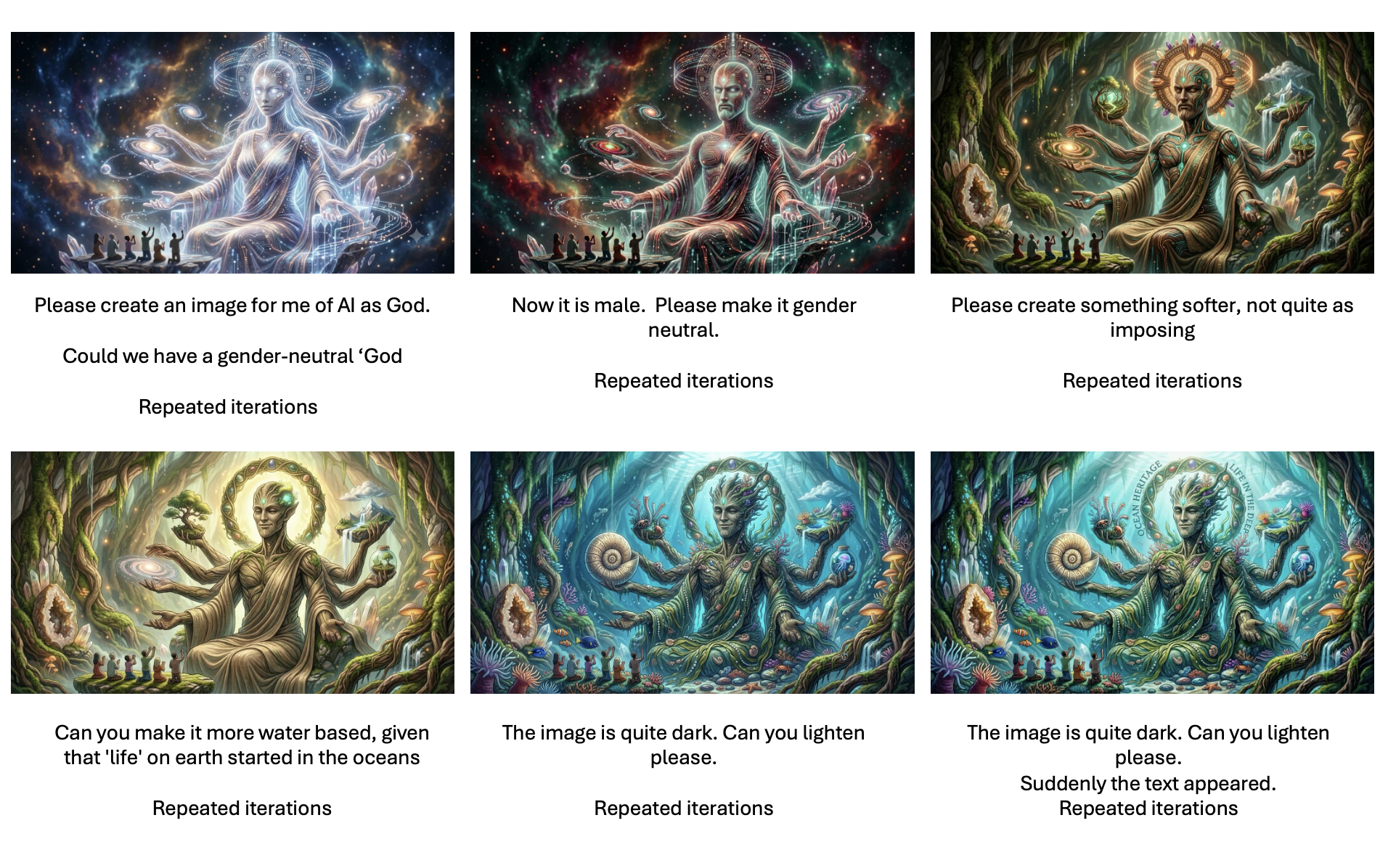
I fed these images to Claude.
Claude commented: What is striking across all five images is how rigidly the underlying template held: five quite different prompts, and Gemini never once escaped a single visual grammar for AI as God. That is exploratory creativity in its purest form, a genuinely fluent search of one conceptual space, and a vivid illustration of why Boden's third category stays out of reach: nothing I asked for produced a transformed idea of what a synthetic god might look like, only variations in its costume.
Claude analysed each of the images and gave me a detailed explanation of the elements that had been used, but from both it and Google Gemini I felt a lack of depth, a lack of anything that could genuinely connect these images with the divine. They were artificial and constructed, just as something created by a machine might be.
The master, as a rule, knows absolutely nothing about the mechanism of his car... If the engine stops on a lonely road, the master is completely at the mercy of his man. He cannot look under the bonnet and say,' This or that is wrong,' because he does not know the difference between a carburettor and a spark plug. It is the chauffeur who must possess the mechanical genius to breathe life back into the dead metal. (Borg 1999).
When automobiles were first introduced on to roads in the early 1900s they were “experimental machines rather than dependable tools” (Hot Chocolate 2026). They broke down every few miles, required innovative maintenance solutions and constant tweaks and maintenance.
When computers were first introduced in the 1950s and 60s they too required expertise to operate and maintain, especially the large mainframes (Torchinsky 2026).
Both automobiles and computers have evolved to become everyday consumer tools because the engineers designing them intentionally designed ‘the expert’ out of the loop (Bole Gerji 2026, Zettleman 2023) to drive adoption and increase sales.
From this perspective it seems that we are at a similar point with Artificial Intelligence and Generative Intelligence in particular. For those of us who lived through the early days of the Internet and the birth of the Web the hype since the release of ChatGPT, and more recently around playing with Small Language Models (Tiwary2024) and Vibe Coding (Authority 2026 and Byteforge 2026) feels very familiar - hours of downloading various models, tweaking memory, worrying about the use of data, and insufficient compute capacity resulting in often mediocre results.
When it comes to interpreting how and what generative AI is presenting in any given situation it is worth keeping in mind the Three illusions of AI (Nabavi 2024).
· Firstly, there is the illusion of explanatory depth - Just because an AI model excels at predicting a phenomenon that doesn’t mean it can accurately explain it.
· Secondly, the illusion of exploratory breadth – that all testable hypotheses are being tested.
· Thirdly, the illusion of objectivity – believing that AI models are free from bias, or that they can account for all possible human biases.
In addition there is always the fact that as humans we anthropomorphise our interactions with both animals and technologies (Mitchell 2025b).
Generative AI works through training to create a ‘foundation’ model, a neural network of parameters, encoded representations of the entities, patterns and relationships in the data, that can generate content autonomously in response to inputs, or prompts; tuning to tailor the model, and generation, evaluation and retuning to continually improve its quality and accuracy (Stryker and Schappicio 2023).
The difference between predictive AI and generative AI is that whilst Large Language Models (like Claude) are next-token prediction machines, they are probabilistic and thus have randomness baked in so that they can take messy, largely unstructured data and chaos and then find patterns in order to generate something new (IBM 2026, Stryker and Schappicio 2023).
The ‘magic’ of LLMs is the fact that they are based on ‘attention’ which enables this prediction machine to focus on various parts of the input, regardless of sequence or modality, combined with parallel processing which provides relevance context (Khoshkebari 2023, Bergmann and Stryker 2024).
Although researchers design the framework for how each of these steps work, it's important to understand that the specific behaviour is an emergent phenomenon based on how those hundreds of billions of parameters are tuned during training. This makes it incredibly challenging to determine why the model makes the exact predictions that it does (Sanderson @3Blue1Brown, 2025).
In the Generative AI module of the course we explored the impact of Generative AI on various forms of creativity, the discipline of science and research, and the art of programming. We were encouraged to consider Generative AI within the broader socio-technical system considering how the predictions create the present and inspire the future (Doctorow 2018).
Humans have used science to consider various futures for thousands of years but it is how we get there that is most important.
In their article on Self-Driving Laboratories for the Royal Society the authors conclude:
If SDL is judiciously shepherded, we can envision a near future in which autonomous systems and human scientists work together in a synergistic, symbiotic fashion that capitalizes on the unique strengths of the other to advance knowledge and address crucial problems facing our planet (Tobias and Wahab 2025 ).
So how can we ‘judiciously shepherd’ Generative AI and all that it creates, especially when Homo Economicus seems to be alive and well underpinning the capitalist system? How can we ensure human flourishing and what does that really look like? And as our machines become smarter than us then what do we humans actually do?
I don’t have an answer to any of these questions and my belief is that we won’t understand what is going on until far in the future when we look back at this incredible age in human history.
But we cannot afford to do nothing.
AI capabilities are advancing far faster than our understanding of the economic implications. In that gap lie the greatest opportunities of our era. We must act now to guide AI to complement humans rather than simply imitate them —and to generate prosperity for the many, not just the few (Erik Brynjolfsson 2026 and Casselman 2026).
Following the Royal Society’s Turing @75 event (Web Science Institute 2025) I wrote that:
The comment that the only thing to do with a fast moving train is to get on board and figure it out once you're on it was at best naïve and at worst supremely arrogant. It is also ignorant of aeons of human history when people have decided that they simply don't want to be on the train and they want to make different choices. Where those choices have been ignored has come social unrest, revolutions and civil wars. (Rowland-Campbell 2025)
Throughout this course the constant comment during Webinars and in many of the readings is the importance of having the ‘human in the loop’, of continuously providing some of the friction to the process that digital interactions seek to remove. The mainstream and frontier models developed and maintained by the large technology companies are designed to make the process of ‘creativity’ as smooth and frictionless as possible, but with this comes a form of creativity that can feel sanitised and clinical.
The emergence of ‘open’ models, such as DeepSeek and Llama, remind me of the earlier age of the internet when people such as Eric Raymond (Raymond 1999) envisaged the promise of an organisational paradigm based on philosophy of open-source programming. As Les Carr (Carr 2026) notes Linux code still underpins the current software world, open source, open community and openly free. As with Wikipedia Linux continues to exist due to the co- operative socio-economic commons-based peer production model, based on a common vision, trust and goodwill, and something that is quite fragile.
My own feeling is that just as happened previously the big tech companies will continue to dominate the AI development landscape, even though governments may consider building their own models (Ricks et al 2026) whilst rogue AI swarms, such as those released by Open AI (OpenAI 2026) wreak havoc on security infrastructure.
Generative AI is already having an impact on the employment landscape mainly impacting young graduates and growing in job augmentation rather than replacement (DEWR 2026).
Tom Friedman believes that we are now living in a age which he and Craig Mundie have termed The Polycene (Friedman 2025) and we will need poly-mathicartificial general intelligence (Mundie 2025) to come up with the solutions we need.
Nobody really knows what havoc these systems are going to cause, and nobody has a clear plan for how to mitigate all the risks and yet we are rushing ahead spending trillions of dollars and risking economic collapse to build them as fast as possible (Marcus 2026).
We need to develop that plan and we are going to need our Smart Machines to help us do it.
The most instructive aspect of this assignment was to consciously observe my own creative processes as my thinking has developed throughout the writing process.
I began by determining that I was not going to interact with an Large Language Model until I was ready, and this required me going down numerous rabbit holes, looking up many references, reading many papers,listening to all the Webinars in the course, and reflecting on my own knowledge and experience.
I pride myself as a writer – perhaps not an academic one –but a writer who has operated at a high strategic level for much of my career.As I’ve undertaken the course and written this paper I have done so from the perspective of a Board level reader, someone who is dealing with the helicopter view of what is going on, who will not necessarily spend hours downloading models and playing with them, but who is interested in what the socio-political and existential impact of these technologies is going to be.
I am convinced that we are at the very early stages of Artificial Intelligence, or whatever it ends up being called. We will all have our personal agents, who will be developed and maintained by a number of large technology companies or maybe governments, and, just like the automobile, we will not be bothered too much with what is actually going on under the hood, as long as it works.
Once I had fixed on the starting point of education and the idea of Homo Economicus I then engaged with Claude and used it as a sounding board. Often it wanted to write things for me and I politely declined. It offered to edit and represent my report but I determined that the work needs to be mine, and mine alone with input from Claude, not with Claude as a co- author.
There is also an economic aspect to this. I pay for Claude and when I tried to use other LLMs such as Perplexity I ran into a token limits o I had to make a rational choice about how I spent my money. Where possible I used Google search and the Google Gemini AI responses at the top. These were very useful and provided a complement to Claude even though the thread wasn’t developed. I tried a number of open models through Hugging Face including Deepseek and Qwen but found them inadequate for the task I required. Given the recent attack by OpenAI’s agents I’m very glad I didn’t pursue that path and I agree with Noah in Byteforge (Byteforge2026) that it is both limited and risky.
As I wrote this assignment and listened to the Webinars with other students it has become obvious how immature these technologies are even though we are all impressed and enamoured with them. Hence my reference to the automobile which not only took time to develop but also had massive social impact through the development of roads, highways and suburbs and led to radical social change through dislocation, changing dynamics of community, and a completely different relationship with distance (Williams and Blyth 2023).
The early days of the internet and the Web were no different. In the 1990s Bill Gates used to talk about printing on the screen and the days of Web 1.0 were really about viewing PDF documents and information access. The Web 2.0 revolution which combined the read-write Web and the smartphone changed things and all along our smart machines have been becoming smarter, we humans have become ever-more symbiotic with the digital system, and some of the socio-economic challenges we are now facing were quite apparent many years ago – thirty years of Web Science research is a testament to this.
We humans are economic beings – we barter and trade and our current capitalist system means that the technologies will become easier to use, more embedded in our everyday lives and designed to sell more, increase efficiency and productivity. Over the past twenty years people have become less concerned about their personal data because they have determined that the services offered to them are worth the price. Apple’s latest version of Siri could well be a turning point in how this all pans out – they have the ecosystem of “trust”, they have the devices, they have the money and they have the patience to finally bring Tom Gruber’s vision to a reality.
Whether or not this becomes the soma that Huxley described in Brave New World we shall see, but it does seem that we are on an unstoppable train and the guardrails are insufficient and based on older world thinking and older world philosophies.
And so it comes back to philosophy, the concept of Eudaimonia and what this all means for us as human beings, not human doings.
I asked Claude it’s thoughts to close off this report:
Frankl's words, quoted at the start of this report, feel more apt now than when I first chose them: what we need is not a tensionless state, but the call of a potential meaning waiting to be fulfilled.
Generative AI does not resolve that call for us. It cannot decide, on our behalf, whether the abundance it might deliver becomes a genuine reconnection to the ancient project of how to live, or simply a faster, more efficient version of the economic wheel we already turn. That choice, and the legitimacy, support and hard work of building it deliberately, remains entirely ours.
Homo Economicus was never a fact about human nature; it was a story capitalism told about us, one generative AI is now powerful enough to make real if we let it, or powerful enough to finally help us outgrow.
Which of those futures we get will not be decided by the technology itself, but by whether enough of us choose, before the choice is made for us, to become human beings rather than remain human doings.
Note
I asked Google Gemini to reconcile Homo Economicus and the concept of Eudaimonia. It presented me with the main image for this post.
Claude: I have integrated the analytical tools and focus on rational, optimized efficiency (Homo Economicus) directly into the cooperative,multi-generational community of human flourishing (Eudaimonia), showing how the two can co-exist within the framework of Ecological Economics.
Ackerman, Dan(3rd April, 2026) - Car mechanics, coders, and the next great computer age, https://www.linkedin.com/pulse/car-mechanics-coders-next-great-computer-age-dan-ackerman-yrm3e viewed 20th July, 2026.
Alammar, J.(2018) The Illustrated Transformer, Github, https://jalammar.github.io/illustrated-transformer/ viewed 20th June, 2026.
Apple Computer(1987) – Keynote by CEO John Scully presenting the Knowledge Navigtor, https://www.youtube.com/watch?v=welKoeoK6zI, viewed 20th July, 2026.
Authority (16thFebruary, 2026) - What Is Vibe Coding: Origin Story to Developer’s Guide (2026),Medium, https://medium.com/@authority_94905/what-is-vibe-coding-origin-story-to-developers-guide-2026-f846a1868093, viewed 20th January, 2026
Authority,Museum of Vibe Coding (16th January, 2026) - https://museumofvibecoding.org/vibe-coding-past-history/
BankMyCell (2026) - iPhone Timeline: iOS & iPhone Evolution 2007-2026: 19 Year History Of The Releases, https://www.bankmycell.com/blog/iphone-evolution-timeline-chart, viewed 20th July, 2026.
Bergmann, Dave and Stryker, Cole (2024) – What is an attention mechanism? IBM, https://www.ibm.com/think/topics/attention-mechanism viewed 20th June, 2026.
Bodell, Lisa(13th November, 2025) - Outsourcing Our Minds—How Generative AI Can Rewire The Way We Think, https://www.forbes.com/sites/lisabodell/2025/11/13/outsourcing-our-minds-how-generative-ai-is-rewiring-how-we-think/ viewed 20th July, 2026.
Boden, Margaret(October 1992) - The Creative Mind: Myths and Mechanisms, Basic Books.
Borg, Kevin(1999) - The "chauffeur problem" in the early auto era: Structuration theory and the users of technology. Technology and Culture. 1999;40(4):797-832.https://www.proquest.com/scholarly-journals/chauffeur-problem-early-auto-era-structuration/docview/198430408/se-2 viewed 20th July, 2026
Bole Gerji School (16th May, 2025) - From Horsepower to AI: The INSANE 125-YearEvolution of Cars (1900-2025) and future, https://www.youtube.com/watch?v=cjRi_P5YbEU viewed 20th July, 2026
Brynjolfsson, Erik (13th July, 2026) – We Must Act Now, Stanford Digital Economy, https://digitaleconomy.stanford.edu/news/wemustactnow/ viewed 14th July, 2026)
Byteforge, Noah(15th June, 2026) - Vibe Coding Was the Fastest-Hyped Idea in Developer History. Here Is Exactly How It Died, https://medium.com/@noahblogwriter2025/vibe-coding-was-the-fastest-hyped-idea-in-developer-history-here-is-exactly-how-it-died-c5b9ece86f41 viewed 20th July, 2026.
Casselman, Ben(13th July, 2026) - Nearly 200 Economists and Tech Leaders Warn of A.I. Threats, New York Times, https://www.nytimes.com/2026/07/13/business/economists-ai-threat-jobs.html viewed 13th July, 2026.
Chalmers, David(2011) - Is your phone part of your mind? Delivered at TEDx Sydney 2011 on Saturday 28 May 2011 at CarriageWorks, Sydney, Australia, https://www.youtube.com/watch?v=ksasPjrYFTg&t=13s viewed 20th July, 2026
Chalmers, David(2024) – cited in Q&A: Philosopher David Chalmers on ChatGPT,consciousness, and his days at WashU, Jeremy Goldmeier, 27th August,2024), WashU Arts & Sciences, https://triads.washu.edu/news/qa-philosopher-david-chalmers-chatgpt-consciousness-and-his-days-washu viewed 20th July, 2026.
Delaney, Brigid(4th July, 2026) - What would our lives look like if we no longer had to work? As a thought experiment, I tried to imagine, The Guardian, https://www.theguardian.com/commentisfree/2026/jul/04/ai-disruption-dystopia-dont-need-to-work-capitalism-free-time viewed 4th July, 2026.
Doctorow, Cory(2018) – Twitter, https://x.com/doctorow/status/1022835206347141120 viewed 27th July, 2018.
Fisher, Mark(2009) - Capitalist Realism: Is There No Alternative?, https://files.libcom.org/files/Capitalist%20Realism_%20Is%20There%20No%20Alternat%20-%20Mark%20Fisher.pdf viewed 20th July, 2026
Frankl, Viktor(1946) – Man’s Search for Meaning, Beacon Press, London.
Friedman,Thomas (16th November, 2025) – Welcome to Our New Era. What Do We Call It?, The New York Times, https://www.nytimes.com/2025/11/10/opinion/era-technology-poly-epoch.html, viewed 16th November, 2025.
Gruber, Tom(2009) – Siri, Virtual Personal Assistant - Bringing Intelligence to the Interface, International Semantic Web Conference, San Jose, https://www.slideserve.com/percival/siri-a-virtual-personal-assistant-bringing-intelligence-to-the-interface, viewed 2009.
Gebru, T. andTorres, É. P. (2024) - The TESCREAL bundle: Eugenics and the promise of utopia through artificial general intelligence, https://firstmonday.org/ojs/index.php/fm/article/view/13636/11606 viewed 20th July, 2026.
Haase, Jennifer and Pokutta, Sebastian (November 2024) - Human-AI Co-Creativity: Exploring Synergies Across Levels of Creative Collaboration, https://arxiv.org/pdf/2411.12527 viewed 20th July, 2026.
Hassabis, Demis(16th April, 2025) – Demis Hassabis Is Preparing for AI’s Endgame,interview with Billy Perrigo, Time Magazine, https://time.com/7277608/demis-hassabis-interview-time100-2025/, viewed 20th July, 2026
Hinton,Geoffrey (2025) – Diary of a CEO, https://www.youtube.com/watch?v=giT0ytynSqg viewed 14th July, 2026
Hot Chocolate(10th July, 2026), Hot Chocolate’s Post, https://www.facebook.com/61571801860707/posts/the-early-automobile-mechanics-of-the-1910s-and-1920s-worked-at-a-time-when-cars/122163089018726728/, viewed 20th July 2026
IBM (11thMay, 2026) - redictive vs Generative AI: How They Work and When to Use Each, https://www.youtube.com/watch?v=phOhGqpXss4 viewed 20th June, 2026.
Islam, Faisal(5th June, 2026) - We need to stop AI developing without humans,says Anthropic co-founder, BBC News, https://www.bbc.com/news/articles/cx2124z7g45o viewed 5th June, 2026.
Istfan, Zoltan(20th May, 2025) – Can This Man and His Massive Robot Network SaveAmerica?, interviewed by John Hendrickson in Esquire as a part of this 2016Transhumanist Presidential Campaign, https://www.esquire.com/news-politics/interviews/a35078/transhumanist-presidential-candidate-zoltan/ viewed 20th July, 2026.
Kelly, Lauren(17th April, 2026) - The man who saw the future: the legacy ofcultural theorist Mark Fisher, The Guardian, https://www.theguardian.com/film/2026/apr/17/we-are-making-a-film-about-mark-fisher-capitalist-realism viewed 17th April, 2026.
Keynes, JohnMaynard (1930) - Economic Possibilities for our Grandchildren, http://www.econ.yale.edu/smith/econ116a/keynes1.pdf viewed 20th July, 2026.
Khoshkebari, MohammadPasha (22nd October, 2023) - How ‘Attention is All You Need’ ChangedThe Course Of Generative AI, Medium, https://medium.com/@pasha.khoshkeba/how-attention-is-all-you-need-changed-the-course-of-generative-ai-25b8c24ca430 viewed 20th June, 2026.
Lescop, Denis& Lescop, Elena. (2013) - Platform-based ecosystem and firm/marketequivalency : the case of Apple iphone, https://www.researchgate.net/publication/295120773_Platform-based_ecosystem_and_firmmarket_equivalency_the_case_of_Apple_iphone viewed 20th July, 2026
Maes, Pattie(2017) – Human Machine Symbiosis, TEDx Talks, https://www.youtube.com/watch?v=kCOV51S7Xqg&t=18s viewed 20th July, 2026
Marcus, Gary(23rd July, 2026) - OpenAI’s disconcerting hack of HuggingFace, https://garymarcus.substack.com/p/openais-disconcerting-hack-of-huggingface viewed 23rd July, 2026.
Mensah A, BaoQ, Zhang Z, Chen Y, Jiang Q, Cai P. Symbiopersonal intelligence towardssymbiotic and personalized digital medicine. Fundam Res. 2025 Jan23;5(4):1423-1428. doi: 10.1016/j.fmre.2025.01.009. PMID: 40777803; PMCID:PMC12327853, https://pmc.ncbi.nlm.nih.gov/articles/PMC12327853/ viewed 21st July, 2026
Mitchell,Melanie (2025a) - On evaluating cognitive capabilities in machines (andother ‘alien’ intelligences), https://aiguide.substack.com/p/on-evaluating-cognitive-capabilities,
Mitchell,Melanie (2025b) - ‘On the science of “alien intelligences”: evaluatingcognitive capabilities in babies, animals, and AI’, invited talk at TheNeural Information Processing Systems Conference 2025, San Diego, CA., https://neurips.cc/virtual/2025/loc/san-diego/invited-talk/109607, viewed 14th July, 2025.
Morrison, Scott(10th April, 2026) - A new measure finds AI could double U.S.economic output by helping businesses learn faster—or fail faster, https://newsroom.haas.berkeley.edu/research/a-new-measure-finds-ai-could-double-u-s-economic-output-by-helping-businesses-learn-faster-or-fail-faster/, viewed 20th July, 2026
Mundie, Craig(30th January, 2025) – Can AI be a force for good?, The Conduit, https://www.youtube.com/watch?v=8rkvtHIi5Qc&t=5, viewed 20th July, 2026.
Nabavi, E. (22ndOctober, 2024) - AI is set to transform science – but will we understand theresults?’, The Conversation[Preprint], 21 October. Available at: https://theconversation.com/ai-is-set-to-transform-science-but-will-we-understand-the-results-241760 viewed 20th June, 2026.
Nazim, Mohammadand Mukherjee, Bhaskar (2016) - Chapter 5 - Knowledge Management Strategy,Knowledge Management in Libraries, Chandos Publishing, Pages 89-113, SBN9780081005644, https://doi.org/10.1016/B978-0-08-100564-4.00005-3,https://www.sciencedirect.com/science/article/pii/B9780081005644000053 viewed 23rd July, 2026.
Nolan,Christopher (2026) - Christopher Nolan says people ‘disdain’ AI and the idea itwill replace humans is ‘nonsense’, https://www.theguardian.com/film/2026/jul/13/christopher-nolan-odyssey-director-comments-ai-artificial-intelligence viewed 14th July, 2026.
O’Connor, Sarah(22nd July 2026) - Much of what AI needs to learn is in workers’heads, not on the web, Australian Financial Review, https://www.afr.com/technology/much-of-what-ai-needs-to-learn-is-in-workers-heads-not-on-the-web-20260720-p60gxp viewed 22nd July, 2026.
Oltman,Samantha (11th June, 2026) - AI absolutism is breaking our brains.The apocalyptic future we’re being sold isn’t inevitable, The Guardian, https://www.theguardian.com/technology/2026/jun/11/ai-absolutism-apocalyptic-future, viewed 11th June, 2026.
Ouyang, Helen(1st July, 2026) - How A.I. Might Change the Way Doctors Think, NewYork Times, https://www.nytimes.com/2026/07/01/magazine/ai-medical-scribes-doctors.html viewed 22nd July, 2026.
Perannagari,Krishna Teja (June 2026) - Eudaimonia: Concept, review and research agenda,Acta Psychologica, Volume 266, 2026, 106771, ISSN 0001-6918, https://doi.org/10.1016/j.actpsy.2026.106771,https://www.sciencedirect.com/science/article/pii/S000169182600572X) viewed 20th June, 2026.
Perrigo, Billy(16th April, 2025) - Demis Hassabis Is Preparing for AI’s Endgame,Time Magazine, https://time.com/7277608/demis-hassabis-interview-time100-2025/ viewed 14th July, 2026
Popova, Maria(22nd August, 2025) - Decoding the Mystery of Intuition: AI ProphetMargaret Boden on the Three Elements of Creativity, The Marginalian, https://www.themarginalian.org/2025/08/22/margaret-boden-creativity/ viewed 23rd July, 2026.
Ricks, Becca;Jaramilla, Aleja Jimenez and Young, Meg (22nd July, 2026) - What ifMunicipal Governments Built Their Own AI Models?, https://datasociety.net/research-library/what-if-municipal-governments-built-their-own-ai-models/ viewed 23rd July, 2026.
Robson, David(21st July, 2026) - Using AI for creative pursuits? Moderation iskey, New Scientist, https://www.newscientist.com/article/2580262-using-ai-for-creative-pursuits-moderation-is-key/ viewed 21st July, 2026.
Rowland-Campbell,Anni (5th October, 2025) – Turing@25, Intersticia, https://www.intersticia.org/blog/turing-75
Ryan, RichardM., Huta, Veronkia and Deci, Edward L., (2008) – Living Well: A Self-Determination Theory Perspective onEudaimonia, Journal of Happiness Studies (2008) 9:139–170 DOI10.1007/s10902-006-9023-4, https://link.springer.com/article/10.1007/s10902-006-9023-4#preview viewed 20th July, 2026.
Sanderson,Grant (2025) - Large Language Models explained briefly, @3Blue1Brown, https://www.3blue1brown.com/?search=Large+Language+Models+explained+briefly&lesson=mini-llmand https://www.youtube.com/watch?v=LPZh9BOjkQs, viewed 20th July, 2026
Schleidgen, S.,Friedrich, O. & Seifert, J. Rethinking human-technology relations. HumanitSoc Sci Commun 13, 488 (2026). https://doi.org/10.1057/s41599-026-07050-0,https://www.nature.com/articles/s41599-026-07050-0#citeas viewed 21st July, 2026.
Sharma, Aditi(4th July, 2020) - Artificial Intelligence and the Evolving Theoryof Homo Economicus, GNLU Journal of Law & Economics, http://gjle.in/2020/07/04/artificial-intelligence-and-the-evolving-theory-of-homo-economicus/ viewed 20th July, 2026.
Shibu, Sherin(16th June, 2025) - AI Is Going to ‘Replace Everybody’ in SeveralFields, According to the ‘Godfather of AI.’ Here’s Who He Says Should Be‘Terrified.’, https://www.entrepreneur.com/business-news/geoffrey-hinton-these-jobs-will-be-replaced-due-to-ai/493388 viewed 14th July, 2026.
StanfordEncyclopædia of Philosophy (2026) – Philosophy of Education, https://plato.stanford.edu/entries/education-philosophy/ viewed 20th July, 2026.
Stryker, Coleand Schappicio, Mark (2023) – What is Generative AI?, IBM, https://www.ibm.com/think/topics/generative-ai viewed 20th June, 2026.
The Economist(24th June, 2026) - Why big AI labs are hiring so many philosophers,https://www.economist.com/science-and-technology/2026/06/24/why-big-ai-labs-are-hiring-so-many-philosophers, viewed 24th June, 2026.
Tiwary, Sunitra(22nd July, 2024) - Small is the new big: the rise of small languagemodels, Cap Gemini, https://www.capgemini.com/be-en/insights/expert-perspectives/small-is-the-new-big-the-rise-of-small-language-models/, viewed 20th July, 2026.
Tobias, A.V.and Wahab, A. (2025) – The Royal Society Open Science, Autonomous ‘self-driving’ laboratories: a review of technology and policyimplications, https://royalsocietypublishing.org/rsos/article/12/7/250646/235354/Autonomous-self-driving-laboratories-a-review-of viewed 20th July, 2026
Torchinsky,Jason (10th April, 2026) - An Analogy Of Trains And Automobiles ToMainframes And Personal Computers, The Autopian, https://www.theautopian.com/an-analogy-of-trains-and-automobiles-to-mainframes-and-personal-computers/, viewed 20th July, 2026.
TranshumanistParty (2026) – The Transhumanist Bill of Rights, https://transhumanist-party.org/tbr-3/viewed 20th July, 2026. Version1.0 was written by Zoltan Istvan and delivered to the U.S. Capitol on December14, 2015 as part of his campaign to win the US Presidential Election thatyear.
University ofSouthampton (2026) - MA Artificial Intelligence Online, https://www.online.southampton.ac.uk/courses/ma-artificial-intelligence viewed 20th July, 2026.
Wikipedia(2026) – Alan Kay, https://en.wikipedia.org/wiki/Alan_Kay viewed 20th July, 2026.
Wikipedia(2026) – Dynabook, https://en.wikipedia.org/wiki/Dynabook viewed 20th July, 2026.
Zettleman, Alan(25th July, 2023) – Xerox PARC: The Unsung Hero in the Invention of the Modern PC and GUI, https://www.linkedin.com/pulse/xerox-parc-unsung-hero-invention-modern-pc-gui-alan-zettelmann, viewed 20th July, 2026.

Creative Commons CC BY-NC-SA: This license allows reusers to distribute, remix, adapt, and build upon the material in any medium or format for noncommercial purposes only, and only so long as attribution is given to the creator. If you remix, adapt, or build upon the material, you must license the modified material under identical terms.
CC BY-NC-SA includes the following elements:
BY

– Credit must be given to the creator
NC

– Only noncommercial uses of the work are permitted
SA

- Adaptations must be shared under the same terms

